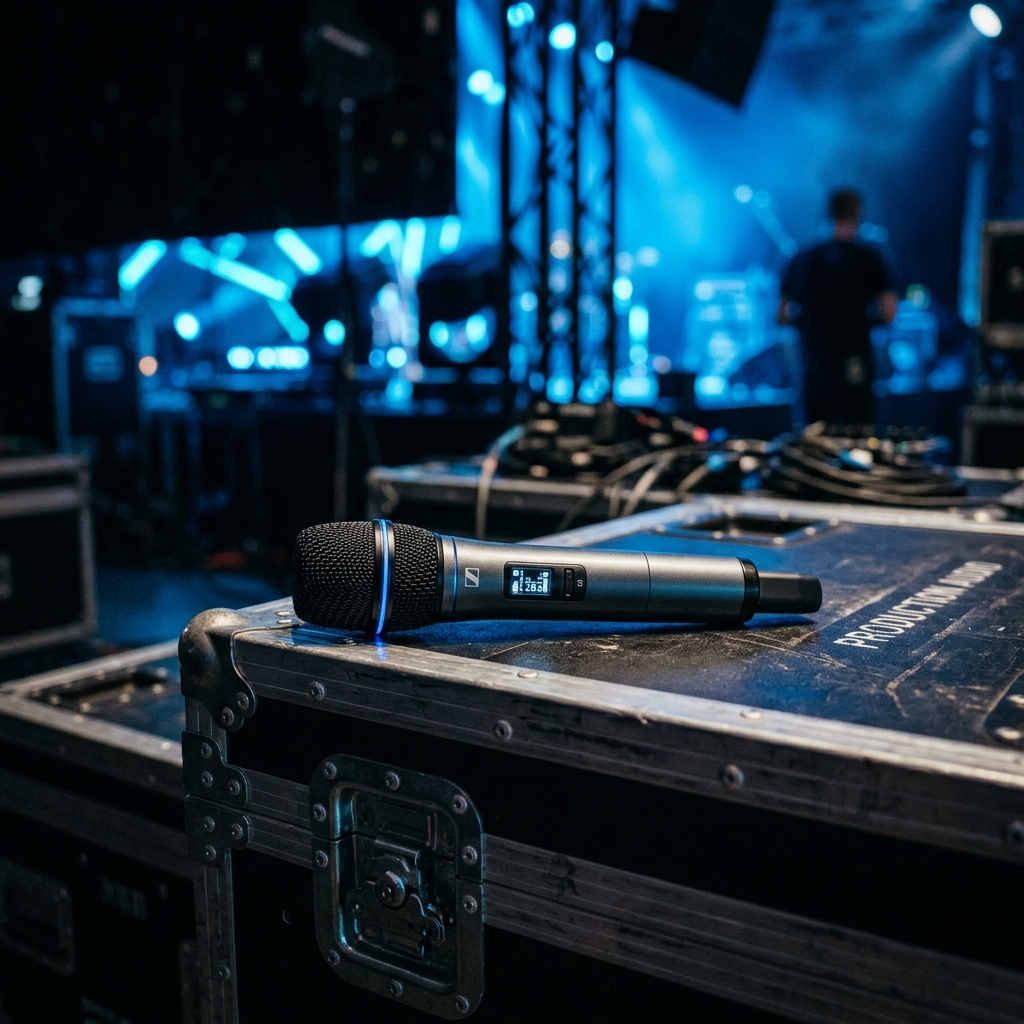
Two Industry Giants, One Critical Decision
But "Shure or Sennheiser?" isn't a simple question with a simple answer. Each manufacturer offers multiple product tiers targeting different budgets and use cases. The differences between their flagship and mid-range lines are significant - and the right choice depends on your event's channel count, RF environment, budget and the specific audio engineer operating the system.
As a production consultancy that specs wireless systems for every type of corporate event - from intimate boardroom presentations to 3,000-person general sessions at Mobile World Congress - we've deployed both brands extensively. Here's an honest, technical breakdown to help you understand what separates them and when each one is the right call.
Shure's Wireless Lineup
Shure's professional wireless portfolio is built on three primary platforms, each targeting a different tier of the market. Understanding where each system sits helps explain why a "Shure system" quote can vary drastically per channel.
Axient Digital (AD Series) - The Flagship
Axient Digital is Shure's top-tier wireless platform, designed for the most demanding live production environments. It's the system you'll find on major award shows, international conferences and broadcast television - anywhere where wireless failure is absolutely unacceptable.
Key capabilities include Quadversity reception, which uses four antenna inputs per channel instead of the standard two, dramatically improving signal reliability in challenging RF environments. ShowLink is a proprietary 2.4 GHz control channel that enables real-time remote monitoring and control of every transmitter from the mix position - the A1 engineer can check battery levels, adjust gain, change frequencies and even reboot a transmitter without touching the physical unit. Interference Detection and Avoidance (IDA) automatically detects interfering signals and moves the channel to a clean frequency in milliseconds, with no audio dropout.
Axient Digital's High Density (HD) mode uses a narrowband transmission scheme that can pack up to 47 channels into a single 6 MHz TV band - critical when you're running 30+ wireless channels at a large pharma conference with multiple breakout rooms. The audio quality is exceptional: 20 Hz–20 kHz frequency response with AES-256 encryption for secure transmission - important for confidential corporate presentations.
ULX-D - The Production Workhorse
ULX-D occupies the sweet spot that most corporate events land in - professional-grade RF performance, excellent audio quality and a significantly lower price point than Axient Digital. It's the system that professional rental houses stock in the greatest quantity because it covers the widest range of applications.
ULX-D offers digital audio with 24-bit, 48 kHz conversion and a wide dynamic range that handles everything from soft-spoken panelists to enthusiastic keynote speakers. The dual and quad receiver form factors pack two or four channels into a single rack unit, saving valuable rack space on multi-channel deployments. Battery options include AA batteries or Shure's SB900 rechargeable packs, which provide runtime monitoring accurate to the minute - no more guessing when a mic will die.
RF coordination is handled through Shure's Wireless Workbench software, which scans the local RF environment, identifies available frequencies and deploys coordinated frequency plans across all receivers. This is the same software platform used with Axient Digital, so engineers familiar with one system can operate the other seamlessly.
SLX-D - The Entry Point
SLX-D is Shure's entry-level digital wireless system, designed for situations where budget is the primary concern but digital audio quality is still required. It's common in small meeting rooms, training sessions and as a supplemental system for breakout rooms at larger events. SLX-D delivers solid audio quality with straightforward setup - up to 32 compatible channels per frequency band - but lacks the advanced RF management, networking and monitoring features of ULX-D and Axient Digital.
Sennheiser's Wireless Lineup
Sennheiser approaches the professional wireless market with its own three-tier structure and each platform brings genuinely different engineering philosophies to the table.
Digital 6000 - The Flagship
The Digital 6000 series is Sennheiser's uncompromising flagship and it represents a fundamentally different approach to wireless RF transmission. While most wireless systems (including Shure's) use a compander - a compressor at the transmitter and an expander at the receiver - to manage dynamic range, the Digital 6000 uses proprietary Long Range (LR) mode that transmits fully uncompressed audio. The result is strikingly transparent sound quality that many audio engineers describe as the most natural-sounding wireless system available.
The Digital 6000's equidistant frequency spacing allows for efficient channel stacking - because the system uses a fixed frequency grid rather than calculated intermod-free frequencies, it simplifies coordination for large channel counts. The Sennheiser WSM (Wireless Systems Manager) software provides comprehensive monitoring and control similar to Shure's Wireless Workbench.
An important practical distinction: the Digital 6000's SK 6212 bodypack transmitter is remarkably compact - one of the smallest professional bodypacks available - making it easier to hide on talent wearing fitted clothing, which is common at corporate presentations and brand activations.
EW-DX - The Mid-Range Contender
EW-DX is Sennheiser's current mid-range digital wireless platform and is the most direct competitor to Shure's ULX-D. Launched as a successor to the popular EW G4 series, EW-DX brings significant improvements: fully digital audio transmission, extended switching bandwidth (up to 88 MHz tuning range in some regions) and Dante/AES67 integration built into the receiver.
The Dante output on the EW-DX receiver is a significant practical advantage for modern corporate AV deployments. Instead of running analog audio cables from the wireless receiver rack to the mixing console, the audio travels over standard Ethernet - reducing cable runs, simplifying setup and enabling the receivers to be positioned near the stage (close to the transmitters for better RF performance) while the console sits at front-of-house, potentially hundreds of feet away.
EW-DX also offers scalable channel counts with up to 146 simultaneous channels per system in optimal conditions. Its auto-scan and auto-frequency setup features make deployment faster for engineers working in unfamiliar RF environments - a common scenario at corporate events where you're in a different hotel or convention center every week.
EW-D - The Entry Point
EW-D is Sennheiser's entry-level digital wireless system, comparable to Shure's SLX-D in market positioning. It offers clean digital audio with simplified setup and is well-suited for fixed installations, small corporate events and supplemental channels. Like SLX-D, it provides solid performance without the advanced RF management and networking capabilities of the higher tiers.
Head-to-Head Comparison
| Feature | Shure Axient Digital | Sennheiser Digital 6000 | Shure ULX-D | Sennheiser EW-DX |
|---|---|---|---|---|
| Market Tier | Flagship | Flagship | Mid-Range | Mid-Range |
| Audio Transmission | Digital, companded | Digital, uncompressed (LR mode) | Digital, companded | Digital |
| Spectrum Efficiency | Up to 47 ch / 6 MHz (HD mode) | Equidistant spacing, high density | Up to 60 ch / band | Up to 146 ch (optimal) |
| Interference Avoidance | IDA (automatic, seamless) | Automatic backup frequency | IR sync, manual | Auto-scan, auto-setup |
| Remote Control | ShowLink (2.4 GHz back-channel) | Sennheiser WSM | Wireless Workbench | Sennheiser WSM / Smart Assist |
| Dante/AES67 Output | Via AD4D receiver | Via EM 6000 Dante | Not built-in | Built-in (EW-DX EM 4 Dante) |
| Bodypack Size | Standard (AD1) | Ultra-compact (SK 6212) | Standard (ULXD1) | Compact (SK-EW-DX) |
| Battery System | Shure SB900A or AA | Sennheiser BA 62 (rechargeable) | Shure SB900A or AA | BA 70 or AA |
| Encryption | AES-256 | AES-256 | AES-256 | AES-256 |
| Price Per Channel (Approx.) | Premium | Premium | Mid-Tier | Mid-Tier |
Ready to Elevate Your Next Event?
FPC delivers flawless AV production for corporate keynotes, product launches and hybrid conferences.
Get a Production QuoteRF Coordination and Spectrum Management
For corporate event planners, RF coordination is the invisible factor that determines whether your wireless microphones work flawlessly or suffer embarrassing dropouts and interference. This is where the differences between Shure and Sennheiser become most technically significant - and where the expertise of your audio engineer matters more than the brand on the receiver.
The RF spectrum available for wireless microphones has been shrinking for years. The FCC's ongoing reallocation of UHF spectrum for cellular broadband (the "spectrum crunch") has reduced the available frequencies for wireless mic operation, particularly in dense urban environments. Convention centers, hotels and arenas in major cities like Toronto, New York and Las Vegas present the most challenging RF environments - dozens of competing wireless systems, cellular interference and LED wall noise all competing for the same spectrum.
Shure's approach centers on Wireless Workbench - a mature, powerful software platform that scans the local RF environment, identifies available frequencies, calculates intermodulation products and deploys coordinated frequency plans. Axient Digital's IDA feature adds real-time backup frequencies that the system switches to automatically if interference is detected. This is a genuine technological advantage for high-channel-count deployments in unpredictable RF environments.
Sennheiser's approach with the Digital 6000 uses equidistant frequency spacing - a mathematically elegant scheme where channels are placed at equal intervals on the spectrum, eliminating intermodulation products entirely. This means you don't need complex intermod calculations; you simply place channels at regular intervals and they coexist cleanly. The EW-DX platform brings auto-scan and auto-setup features that simplify deployment for engineers working in venues they've never been to before.
In practice, both approaches work extremely well when operated by experienced RF coordinators. The brand choice matters less than the person doing the coordination. A skilled A1 engineer with either platform will deliver flawless wireless performance; an inexperienced operator with either brand will have problems.
Lavalier and Handheld Quality
The transmitter and receiver are only half the equation - the microphone capsule itself has a massive impact on the sound quality your audience hears. Both Shure and Sennheiser offer excellent lavalier and handheld options, but they have distinctly different sonic characteristics that matter for corporate speech applications.
Shure lavaliers. The most commonly specified Shure lavalier for corporate events is the MX150, a subminiature omnidirectional capsule that delivers clear, natural speech reproduction with excellent off-axis consistency. For higher-end applications, the TwinPlex TL46 and TL47 offer improved high-frequency detail and noise rejection. The DuraPlex DL4 is the go-to for situations where durability matters - outdoor events, active presenters and multi-day conferences where lavs get handled roughly.
Sennheiser lavaliers. Sennheiser's MKE 1 is legendary among audio engineers for its incredibly small size (only 3.3mm diameter) and transparent sound quality. It's the lavalier most commonly used on broadcast television and film sets where the mic must be completely invisible. For corporate events, the ME 2-II is a reliable omnidirectional option that pairs well with the EW-DX system, while the MKE Essential delivers natural speech with improved sensitivity.
Handheld capsules. This is where personal preference and vocal characteristics play a significant role. Shure's SM58-based capsules have a midrange presence peak that helps voices cut through room noise - the "Shure sound" that engineers have relied on for decades. Sennheiser's MD series capsules and the KK 205 condenser tend toward a flatter, more neutral response that some engineers prefer for polished corporate presentations. Neither is objectively "better" - it depends on the speaker's voice, the room acoustics and the sound engineer's preference.
Which System for Which Event
Rather than declaring a universal winner, here's our honest assessment of when each system excels, based on real-world deployments across hundreds of corporate events:
Choose Shure Axient Digital when: You're running 20+ wireless channels in a convention center or arena environment. The IDA interference detection is invaluable when you can't fully control the RF environment. Large-scale pharmaceutical conferences (for clients like Sanofi, BeiGene, IPSEN and UCB), multi-day festivals and events sharing space with other productions benefit most from Axient's automated spectrum management and ShowLink remote control.
Choose Sennheiser Digital 6000 when: Audio quality is the absolute top priority and you have a skilled RF coordinator. The uncompressed transmission in LR mode delivers the most transparent wireless audio available. The ultra-compact SK 6212 bodypack is ideal for executives and presenters in fitted corporate attire where hiding a bodypack matters. Automotive brand reveals and product launches where the audience and the broadcast mix are equally important.
Choose Shure ULX-D when: You need reliable, professional wireless on a mid-range budget. It's the default workhorse for most corporate events - general sessions, breakout rooms, panel discussions - where you need 4–16 channels with excellent quality and don't require the advanced RF management of Axient. Most rental houses carry ULX-D in significant quantity, making it the easiest system to source.
Choose Sennheiser EW-DX when: You want Dante integration out of the box, which is increasingly common in modern corporate AV systems. The auto-scan and auto-setup features make it efficient for touring events or multi-city conference series where the RF environment changes at every stop. It's also an excellent choice when your audio infrastructure already uses Dante networking - the receivers connect directly to the network without requiring additional interface hardware.
What FPC Recommends
As a vendor-agnostic production consultancy, we don't have a horse in this race. We don't own Shure inventory or Sennheiser inventory. We don't get paid more for specifying one brand over the other. Our only interest is making sure our clients' events sound flawless - which is exactly how a production consultant should operate.
In practice, here's how we approach wireless microphone specification across our 500+ show days of experience:
We spec to the event's requirements, not to a brand preference. A 12-channel corporate keynote in a hotel ballroom doesn't need Axient Digital - ULX-D or EW-DX will perform identically at a lower cost. A 40-channel pharmaceutical conference in a convention center absolutely does need Axient Digital or Digital 6000 because the RF complexity demands it.
We match the system to the A1 engineer. An audio engineer who has spent their career on Shure systems knows every menu, every troubleshooting step and every quirk of that ecosystem. Putting them on Sennheiser for a high-stakes show introduces unnecessary risk. We ask our engineers what they're most comfortable and experienced with and we spec accordingly - because the operator's expertise matters more than any spec sheet comparison.
We always spec backup channels. Regardless of brand, we never send a wireless microphone to a stage without a hot backup ready to go. For critical presenters - your CEO, your keynote speaker, your product launch MC - we have a second bodypack and lavalier dressed and tested, sitting on a tray backstage. The brand of those backups? It's whatever's available from the rental house and compatible with the system. Reliability comes from redundancy and preparation, not from brand loyalty.
If you're planning an event and need help determining the right wireless microphone approach, reach out to us. We'll assess your event's specific channel count, venue RF environment and budget to recommend the right system - not the most expensive one.