Every industry has its own language and audiovisual production is no exception. When you sit down with your AV partner to plan a corporate event, the conversation will inevitably include terms like IMAG, line array, pixel pitch, DMX and FOH - and knowing what those terms mean is the difference between being an informed decision-maker and nodding along hoping for the best. We built this corporate event AV glossary after 500+ show days producing events for brands like Ferrari, Porsche, the NFL, Sanofi and BeiGene. These are the terms our clients ask us about most often, defined in plain English with the context you actually need. If you want to understand what an AV production company actually does, this glossary is the perfect companion. And if you have questions about any term here, our team is always available - just reach out.
A
A1 (Audio Engineer / Audio Lead)
The A1 is the lead audio engineer responsible for mixing all sound at an event. The A1 sits at the FOH position, operates the mixing console and makes real-time decisions about microphone levels, EQ and overall audio quality. On FPC productions, our A1 is the single point of authority for everything the audience hears. See our audio production capabilities.
Aspect Ratio
The proportional relationship between the width and height of a display or video image. The most common aspect ratio for corporate events is 16:9 (widescreen), which matches standard presentation software and HD video. Ultrawide formats like 32:9 are increasingly used for panoramic LED stages. Getting the aspect ratio wrong means your content will either be stretched, cropped or letterboxed - none of which look professional.
B
Backline
Equipment and instruments positioned on or behind the stage that performers or presenters use during a show. In corporate events, backline typically refers to items like keyboard risers, music stands, DJ setups or specialized equipment for live demonstrations. Not to be confused with the audio system itself.
Barn Doors
Adjustable metal flaps attached to the front of a lighting fixture used to shape and control the light beam. Barn doors allow the lighting designer to cut light off specific areas - preventing spill onto screens, into the audience or onto areas that should remain dark. They are a simple but essential tool for precise lighting control.
Bitrate
The amount of data transmitted per second in a video or audio stream, measured in kilobits per second (kbps) or megabits per second (Mbps). Higher bitrate means higher quality but requires more bandwidth. For corporate event livestreams, we typically encode at 5–10 Mbps for 1080p video to balance quality with reliable delivery.
Bonded Cellular
A streaming technology that combines multiple cellular data connections (from different carriers) into a single, more reliable internet connection. Devices like the Teradek Bond and LiveU use bonded cellular as a primary or backup streaming path when dedicated hardwired internet is unavailable or unreliable. FPC deploys bonded cellular as a redundancy layer on every critical livestream.
Bridle
A rigging configuration using two or more steel wire ropes or slings that converge at a single point to distribute a load across multiple attachment points. Bridles are used when a single rigging point cannot be placed directly above the load - for example, when hanging truss between two ceiling beams. All bridle calculations must account for load angles and are performed by certified riggers.
C
Call Time
The scheduled arrival time for crew members at the venue. Call time is typically 2–3 hours before doors open for a standard corporate event and significantly earlier for complex productions requiring extensive setup. Every FPC production starts with a detailed call sheet that specifies staggered call times for different departments - rigging crew first, then lighting, video, audio and finally show operators.
Chain Hoist
An electric or manual lifting device used to raise and lower truss, lighting rigs, LED walls, speakers and other production equipment. Electric chain hoists (commonly called motors) are the standard in corporate event rigging. Common brands include CM Lodestar and Chainmaster. All hoists used at FPC productions are load-rated and inspected.
Compression (Audio)
An audio processing technique that reduces the dynamic range of a signal - making quiet sounds louder and loud sounds quieter. In live corporate events, compression is applied to microphones to ensure that a speaker who varies between speaking softly and emphatically remains consistently audible throughout the room. Proper compression is invisible to the audience - they simply hear clear, even speech.
Confidence Monitor
A display screen positioned at the front of the stage, facing the presenter, that shows the current slide or presentation content. Confidence monitors allow speakers to see what the audience sees without turning their back to the room. For keynote presentations, FPC typically deploys confidence monitors combined with a presenter timer and next-slide preview.
Cue-to-Cue
A rehearsal format where the production team runs through every technical transition in the show - lighting changes, video rolls, audio cues, slide advances - without running the full program content. Cue-to-cue rehearsals are the most efficient way to verify that all technical elements are programmed correctly and that the crew is aligned on timing. FPC recommends a cue-to-cue rehearsal for any production with more than five technical cues.
D
Dead Hang
A rigging method where equipment is hung from a fixed point without the ability to adjust its height. Dead hangs are used when motors are not required or not available - common in hotel ballrooms with low ceilings. The equipment is hung at a fixed height during load-in and remains there for the duration of the event.
DI Box (Direct Injection Box)
A device that converts a high-impedance, unbalanced audio signal (like from a keyboard, laptop or electric guitar) into a low-impedance, balanced signal that can travel long distances over XLR cable without noise or signal loss. DI boxes are essential at corporate events for connecting presenter laptops, playback devices and musical instruments to the audio system.
DMX (Digital Multiplex)
The standard digital communication protocol used to control stage lighting fixtures. DMX512 transmits up to 512 channels of control data over a single cable, allowing a lighting console to manage hundreds of fixtures - controlling their intensity, color, position, gobo selection and effects. Every professional lighting system at a corporate event runs on DMX.
E
Encoding
The process of converting a raw video and audio feed into a compressed digital format suitable for livestreaming or recording. Encoding is performed by hardware encoders (Teradek, AJA) or software (OBS, vMix). The encoder takes the program feed from the video switcher and compresses it for delivery via RTMP or SRT to a streaming platform or CDN.
EQ (Equalization)
The process of adjusting the frequency balance of an audio signal. In live events, EQ is used to shape microphone signals (removing low-frequency rumble, adding presence to speech), tune the PA system to the room (compensating for room acoustics) and eliminate feedback. A skilled A1 uses EQ to ensure every voice sounds natural and every piece of music sounds balanced in the specific room.
F
Feedback
The high-pitched squeal or howl that occurs when a microphone picks up its own amplified signal from a speaker, creating a loop. Feedback is the most recognizable (and most dreaded) audio problem at events. It is prevented through proper microphone placement, speaker positioning, EQ and gain staging - all techniques that FPC's audio engineers manage as standard practice.
FOH (Front of House)
The technical control position located in the audience area, typically at the center-rear of the room, where audio and video engineers operate mixing consoles, video switchers and other control equipment. The FOH position requires a clear, unobstructed sightline to the stage. At FPC productions, FOH is the command center where our A1, V1 and stream operators manage the entire show in real time.
Follow Spot
A powerful, manually operated lighting fixture that produces a focused beam of light used to track and illuminate a presenter or performer as they move across the stage. Follow spots are essential for keynote speakers in large ballrooms or arenas where stage wash alone cannot provide adequate visibility. The follow spot operator typically works from the back of the room or a designated spotlight position.
Fresnel
A type of lighting fixture named after its Fresnel lens, which produces a soft-edged beam of light. Fresnels are commonly used as key lights and fill lights on stages because their soft edge blends smoothly with other fixtures, avoiding harsh shadows on presenters' faces. They are a staple of corporate event and broadcast lighting.
G
Gaffer Tape
A heavy-duty, cloth-backed adhesive tape that is the universal problem-solver on every production. Unlike duct tape, gaffer tape is designed to be removed cleanly without leaving residue on floors, cables or equipment. It is used to secure cables to the floor, mark stage positions, label equipment and solve approximately one thousand other problems that arise during load-in and show day. No production toolkit is complete without it.
Gain Staging
The process of setting the proper signal level at each point in the audio chain - from microphone to preamp to console to processor to amplifier. Proper gain staging ensures the audio signal is strong enough to overcome noise but not so strong that it distorts. Poor gain staging is one of the most common causes of audio quality problems at corporate events and is one of the first things FPC's audio engineers address during system setup.
Genlock
A technique for synchronizing the timing of multiple video sources so they can be mixed, switched or displayed together without visual glitches (tearing, rolling or flashing). Genlock ensures that all cameras, media servers and graphics sources are frame-synchronized. In corporate events with multi-camera IMAG and LED walls, proper genlock is essential for clean video switching.
Gobo
A thin metal or glass disc with a pattern cut or etched into it, placed inside a lighting fixture to project a shaped image - such as a company logo, geometric pattern or texture - onto a stage, wall or floor. Gobos are a cost-effective way to add branded visual elements to a corporate event without building physical scenic pieces. Custom gobos can be manufactured with any logo or design.
Green Room
A backstage area where speakers, presenters and VIPs can wait, prepare and relax before going on stage. The green room is typically equipped with comfortable seating, refreshments, a monitor showing the live stage feed and a production assistant who can relay timing cues. FPC coordinates with venue teams to ensure the green room is properly connected to the production comms system.
H
Handheld Microphone
A wireless microphone designed to be held in the hand, commonly used for audience Q&A, emcees and presenters who prefer a traditional microphone. Handheld wireless mics (Shure, Sennheiser) contain a built-in transmitter and capsule. FPC keeps multiple handhelds in rotation with fresh batteries for every session of a corporate event.
Haze
A fine atmospheric effect produced by a haze machine that fills the room with a thin, even fog. Haze makes light beams visible - without it, moving head beams, gobos and wash effects are invisible in the air and only appear where they hit a surface. Haze is essential for any event with dramatic lighting design. Always coordinate with the venue's fire marshal and HVAC team before using haze, as it can trigger smoke detectors.
I
IMAG (Image Magnification)
The live video display of a presenter or performer on large screens so that audience members far from the stage can see them clearly. IMAG is captured by dedicated cameras (typically two or more), mixed through a video switcher and displayed on side screens or the main LED wall. IMAG is standard at any corporate event with more than 200 attendees or a viewing distance exceeding 40 feet.
Intelligent Lighting
Automated lighting fixtures that can be remotely controlled to change position (pan and tilt), color, intensity, beam shape, gobo pattern and effects via DMX. Intelligent lights - including moving heads, moving mirrors and LED profile fixtures - allow a lighting designer to create dynamic, programmable looks that change throughout a show without physically repositioning fixtures.
K
Key Light
The primary light source illuminating a presenter or subject on stage. The key light is the most important single fixture in stage lighting because it determines how the speaker looks to the audience and on camera. FPC positions key lights at approximately 45 degrees horizontal and 45 degrees vertical from the presenter for natural, flattering illumination that eliminates harsh shadows.
Ready to Elevate Your Next Event?
FPC delivers flawless AV production for corporate keynotes, product launches and hybrid conferences.
Get a Production QuoteL
Lavalier Microphone
A small, clip-on microphone worn on the presenter's clothing, typically attached near the collarbone or tie knot. Lavalier mics (commonly called lavs) are connected to a wireless bodypack transmitter and provide hands-free audio for speakers who move around the stage or need to use their hands for demonstrations. Proper lav placement is critical - too low and the audio is muffled, too high and it picks up jaw noise.
LD (Lighting Designer)
The creative and technical lead responsible for designing and operating the lighting for an event. The LD determines fixture selection, positioning, color palette, cue programming and real-time operation during the show. At FPC, our LD collaborates with the client during the design phase to create lighting looks that reinforce the event's brand identity and emotional tone.
LED Panel
A modular display tile composed of light-emitting diodes that is combined with other panels to create large-format LED video walls. LED panels come in various pixel pitches (the distance between individual LED pixels) - smaller pixel pitch means higher resolution for closer viewing distances. Common brands in corporate events include ROE Visual, Absen and Unilumin.
Leko (Ellipsoidal Reflector Spotlight)
A lighting fixture that produces a hard-edged, precisely focused beam of light. Lekos (also called Source Fours, after the popular ETC model) can project gobos, accept shuttering to shape the beam and are used as key lights, specials and gobo projectors. They are the workhorse of corporate event and theatrical lighting.
Line Array
A loudspeaker system composed of multiple speaker elements arranged in a vertical line and typically hung from rigging above the stage. Line arrays (like JBL VTX, d&b audiotechnik, L-Acoustics KARA) project sound over long distances with consistent volume from front to back, making them the standard main PA system for corporate events with more than 200 attendees. Our audio team sizes and configures line arrays based on room geometry and audience coverage requirements.
Load Cell
An electronic sensor installed between a rigging point and the load (truss, motor or equipment) that continuously measures the weight being supported. Load cells provide real-time weight monitoring during rigging operations, alerting the crew if any point approaches its rated capacity. They are an essential safety tool for any production with overhead rigging.
Load-In
The process of delivering, unloading and setting up all production equipment at the venue. Load-in follows a specific sequence - typically rigging first, then staging, lighting, video, audio and finally scenic and branding elements. A well-planned load-in is critical for staying on schedule and avoiding overtime venue charges.
M
Monitor Mix
A separate audio mix sent to speakers or in-ear monitors on stage so that presenters or performers can hear specific audio sources - such as their own voice, music or a remote participant's audio. Monitor mixes are independent from the main FOH mix that the audience hears. For corporate events with panel discussions or hybrid formats, FPC provides custom monitor mixes so panelists can clearly hear remote participants.
Motor Point
A designated location in a venue's ceiling structure where a chain hoist motor can be safely attached to raise and lower production equipment. Motor points are determined by the venue's structural engineer and have rated weight capacities. During venue assessment, FPC documents all available motor points, their capacities and their positions relative to the planned stage and production layout.
Moving Head
An intelligent lighting fixture mounted on a motorized yoke that allows it to pan (rotate horizontally) and tilt (rotate vertically) via DMX control. Moving heads can be programmed to project beams, washes, spots and patterns in any direction, providing dynamic lighting effects that change throughout a show. They are the most versatile fixtures in a corporate event lighting rig.
N
NDI (Network Device Interface)
A software standard developed by NewTek that enables video and audio to be transmitted over standard Ethernet networks. NDI allows cameras, computers and video devices to share video feeds over a local network without dedicated video cabling (SDI or HDMI). NDI is increasingly used in corporate event production for connecting cameras to switchers, feeding confidence monitors and integrating remote presenters.
P
PAR Can
A simple, durable lighting fixture that produces a fixed, wide beam of light. PAR (Parabolic Aluminized Reflector) cans have largely been replaced by LED PAR fixtures in modern production, but the term persists. LED PARs are used extensively for stage washes, uplighting and color effects at corporate events because they are lightweight, energy-efficient and can produce any color via RGB or RGBW mixing.
Phantom Power
A method of providing DC electrical power (typically 48 volts) through audio cables to condenser microphones and active DI boxes that require external power to operate. Phantom power is supplied by the mixing console or audio interface and travels through the same XLR cable that carries the audio signal. It is essential for many professional microphones used at corporate events and must be engaged on the correct channels during setup.
Pixel Pitch
The distance, measured in millimeters, between the center of one LED pixel and the center of the adjacent pixel on an LED video wall. Smaller pixel pitch means higher resolution and is required for closer viewing distances. For example, a 2.6mm pixel pitch panel is suitable for viewing distances of 8 feet or more, while a 1.5mm pitch panel is needed when the audience is within 5 feet. FPC selects pixel pitch based on the actual front-row viewing distance in each venue.
Podium Microphone
A gooseneck or flush-mount microphone permanently mounted on a podium or lectern. Podium mics provide reliable audio for speakers who present from a fixed position. They are typically condenser microphones with cardioid pickup patterns to reject room noise and focus on the speaker's voice. FPC installs podium mics as part of the standard lectern setup on every corporate event.
R
Redundancy
The practice of deploying backup systems that can take over immediately if the primary system fails. In event production, redundancy applies to every critical system: backup media servers, redundant internet connections for streaming, spare microphones, duplicate power feeds and backup playback devices. FPC designs redundancy into every production because show-stopping failures are not recoverable in live events.
Rehearsal
A scheduled practice session where presenters, crew and production systems run through the event program - either in full or as a cue-to-cue - to identify and resolve issues before the live show. FPC recommends at minimum a technical rehearsal the evening before or morning of every corporate event, with a full run-through for events with complex cues, multiple presenters or livestreaming.
RF Coordination
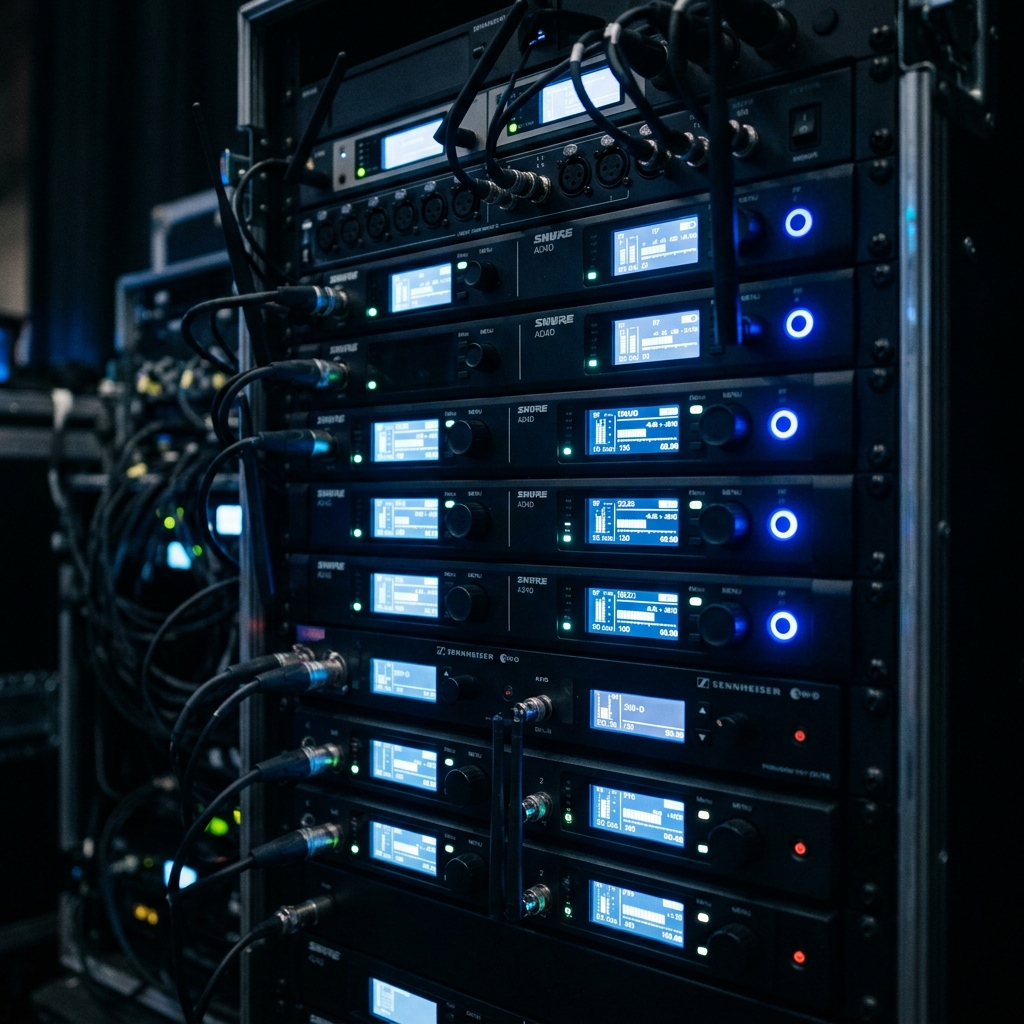
The process of scanning the radio frequency spectrum at the venue and assigning clean, non-interfering frequencies to all wireless microphones, in-ear monitors and communication systems. RF coordination is critical at convention centers and hotels where dozens of wireless devices may be operating simultaneously across multiple events. FPC performs RF scans during load-in and uses professional coordination tools to ensure interference-free wireless operation.
RTMP (Real-Time Messaging Protocol)
A streaming protocol used to deliver live video and audio from an encoder to a streaming platform or CDN. RTMP is the most widely supported ingest protocol for platforms like YouTube Live, Vimeo and custom streaming servers. While newer protocols like SRT are gaining adoption, RTMP remains the standard for most corporate event livestreams.
S
Scaler
A video processing device that converts video signals from one resolution, frame rate or format to another. Scalers are essential at corporate events because presenter laptops output video at varying resolutions and refresh rates. Professional scalers (Barco E2, Analog Way Aquilon) ensure that every input - regardless of source format - is cleanly converted to match the output resolution of the screens or LED walls.
Span Set
A continuous loop of polyester webbing used as a sling in rigging to connect truss, motors or equipment to structural attachment points. Span sets are rated for specific weight capacities and are preferred over steel wire rope in many applications because they are lighter, less likely to damage building structures and easier to handle. They must be inspected before every use.
SRT (Secure Reliable Transport)
A modern streaming protocol designed to deliver high-quality, low-latency video over unpredictable networks (including the public internet). SRT provides better error correction and lower latency than RTMP, making it increasingly popular for corporate event streaming where real-time interaction (Q&A, polling) is important. FPC uses SRT when platform support is available and latency requirements demand it.
Strike
The industry term for tearing down and removing all production equipment from a venue after an event. Strike follows the reverse order of load-in: audio and video equipment is removed first, followed by lighting, scenic elements, staging and finally rigging (which must come down last for safety reasons). A well-organized strike minimizes overtime charges and reduces the risk of equipment damage.
Switcher (Video Switcher)
The central video mixing device that allows the V1 operator to select, cut, dissolve or transition between multiple video sources - cameras, media servers, presentation laptops and graphics - to create the live program output. Professional switchers used at corporate events include Ross Carbonite, Blackmagic ATEM and Grass Valley. The switcher is the video equivalent of the audio mixing console.
T
TD (Technical Director)
The person responsible for overseeing all technical aspects of a production, coordinating between audio, video, lighting, rigging and streaming departments. The TD is the central point of communication for the production crew and serves as the bridge between the client/event manager and the technical team. At FPC, our TD - often founder Andrew Florencia - manages the entire production from design through execution.
Tech Rider
A document provided by a speaker, performer or production team that specifies all technical requirements for an event - including microphone preferences, monitor requirements, stage dimensions, power needs and any special equipment. Tech riders are common in entertainment but are increasingly used by corporate keynote speakers and executive presenters. FPC reviews all tech riders during the planning phase and incorporates requirements into the production spec.
Throw Distance
The distance from a projector lens or lighting fixture to the surface it illuminates. Throw distance is a critical specification for projectors - it determines how large the image will be at a given distance and which lens is required. For lighting, throw distance affects beam spread and intensity. FPC calculates throw distances during venue assessment to ensure proper projector and lighting fixture selection.
Truss
Aluminum or steel structural frameworks used to support lighting fixtures, speakers, LED panels, scenic elements and other production equipment overhead. Truss comes in various configurations - box truss, triangular truss, ladder truss - and is assembled on the ground before being raised into position by chain hoists. All truss systems at FPC productions are rated, certified and inspected before use.
U
Uplighting
LED fixtures placed on the floor and aimed upward to illuminate walls, columns, drape or architectural features with colored light. Uplighting is one of the most cost-effective ways to transform a bland hotel ballroom into a branded event environment. FPC uses uplighting matched to client brand colors to create immersive atmospheric effects throughout the venue.
V
V1 (Video Engineer / Video Lead)
The lead video engineer responsible for operating the video switcher and managing all video sources and outputs at an event. The V1 selects camera shots, triggers video playback, manages presentation inputs and ensures the program feed looks broadcast-quality on screens, IMAG displays and livestream outputs. The V1 works closely with the TD and camera operators throughout the show.
W
Wash (Lighting)
A broad, even spread of light covering a large area of the stage. Stage wash provides the base layer of illumination that ensures presenters are visible across the full stage width and depth. Wash fixtures (LED wash panels, fresnels, PAR cans) are positioned and focused to create smooth, shadow-free coverage. Wash is the foundation upon which all other lighting effects - key lights, specials, accents - are layered.
This corporate event AV glossary covers the terms you are most likely to encounter when planning a corporate event with professional AV production. Understanding this vocabulary will help you communicate more effectively with your production partner, ask better questions during planning meetings and make more informed decisions about your event's technical requirements. If you are ready to start planning your next event, FPC's team - with 13+ years of experience and over 100 brands served across North America - is here to help you build something extraordinary. Let's talk about your show.