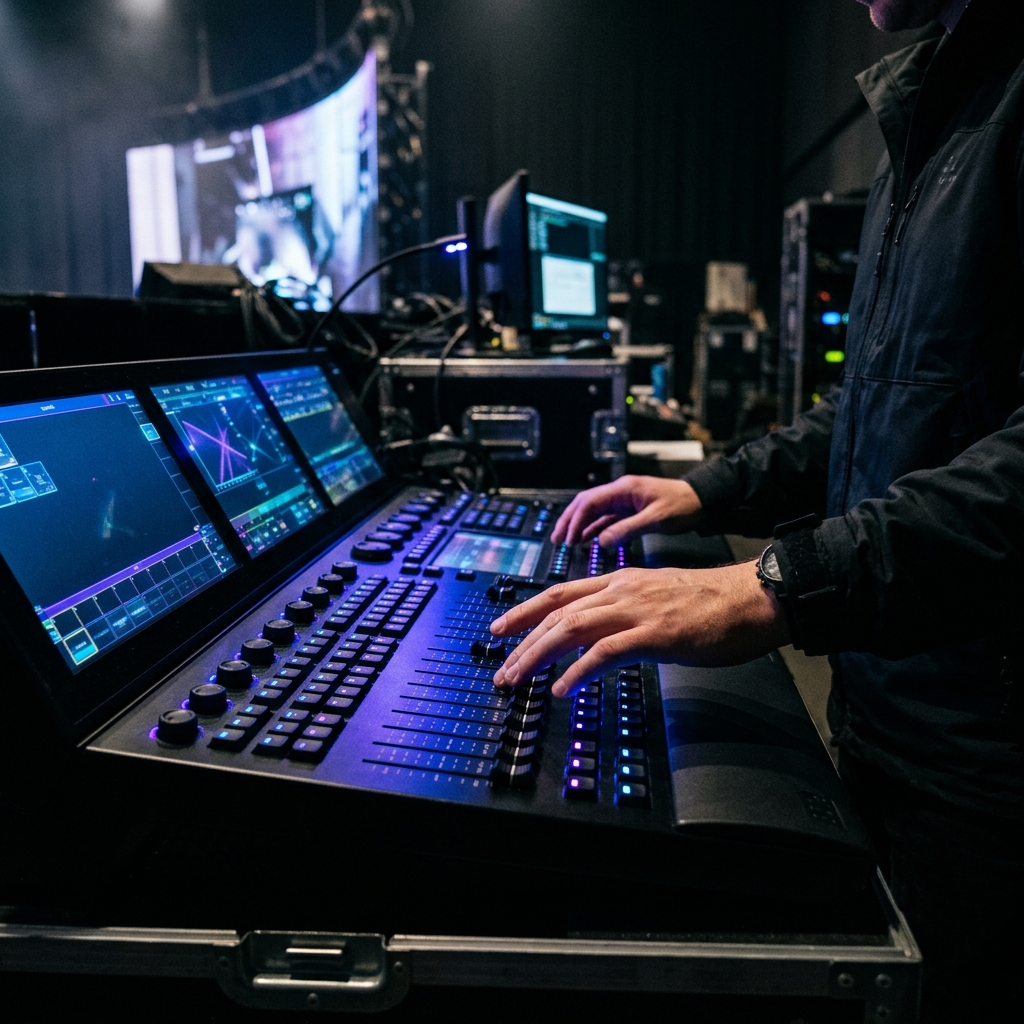
Two Lighting Control Philosophies
MA Lighting, the German manufacturer behind the grandMA series, approaches lighting control as a data management problem. Their consoles are built to handle enormous quantities of parameters - hundreds of thousands simultaneously - with a structured, hierarchical programming model that rewards meticulous show file architecture. The GrandMA3 platform treats every attribute of every fixture as a discrete data point that can be manipulated, layered and networked across multiple consoles and processing units.
Avolites, the British manufacturer with decades of heritage in rock-and-roll touring, approaches lighting control as a creative performance tool. Their Titan software prioritizes speed, visual feedback and intuitive operation. Where GrandMA3 asks you to build a precise data structure, Avolites invites you to grab fixtures and start painting with light - making creative decisions first and organizing later.
Neither philosophy is inherently superior. They serve different production contexts, different types of lighting designers and different event requirements. For corporate event lighting design, both platforms deliver professional results - but the right choice depends on the specific demands of your production.
GrandMA3 Overview: MA Lighting's Flagship
The GrandMA3 platform represents MA Lighting's third generation of professional lighting control, released in 2018 and continuously updated since. It builds on the legendary grandMA2 - arguably the most widely deployed professional lighting console in history - while introducing a completely rebuilt software architecture and a new hardware lineup.
Hardware lineup. The GrandMA3 family includes the full-size grandMA3 (with 22 motorized faders, 36 executors and dual 15.6" touchscreens), the grandMA3 light (a more compact version with 16 motorized faders), the grandMA3 compact XT (with a built-in touchscreen and reduced footprint for smaller productions) and the grandMA3 onPC command wing - a cost-effective USB wing that runs the full MA3 software on a laptop or desktop computer. The onPC solution has made the MA3 ecosystem accessible to a much wider range of productions, from small corporate events to regional theatre.
MA-Net3 networking. One of GrandMA3's most significant advantages is its networking architecture. MA-Net3 allows multiple consoles and processing units (called NPUs - Network Processing Units) to work together as a single unified system. A lighting designer can have a primary console at front-of-house, a backup console on the same network and additional NPUs expanding the total parameter count - all sharing the same show file in real time. For large corporate events with multiple stages or rooms, this multi-user, multi-console capability is genuinely powerful. Multiple programmers can work on different sections of a show file simultaneously during setup, significantly reducing programming time on complex productions.
Parameter handling. The GrandMA3 platform can handle over 250,000 parameters - meaning it can control enormous fixture rigs without performance degradation. For reference, a single high-end LED wash fixture like the Robe ESPRITE might use 40+ DMX channels, so a rig of 200 such fixtures would consume 8,000+ parameters. The MA3's headroom means you're never going to hit a parameter ceiling, even on the largest corporate general sessions or arena productions.
Phaser engine. GrandMA3's phaser engine is its primary tool for creating dynamic, moving effects - chases, waves, fans and complex multi-step animations across groups of fixtures. The phaser system is extraordinarily powerful, allowing lighting designers to create intricate looks with precise mathematical control over speed, direction, phase offset and waveform. However, this power comes with complexity; the phaser workflow requires a solid understanding of the underlying mathematics to use effectively.
GDTF and MVR support. GrandMA3 was the first major platform to embrace GDTF (General Device Type Format), an open standard for fixture profiles and MVR (My Virtual Rig), a standard for exchanging 3D stage data between lighting consoles, visualizers and CAD software. This commitment to open standards means better interoperability with tools like Vectorworks, Capture and other design software used in professional AV production.
Avolites Overview: Titan, Sapphire and Diamond
Avolites has been building lighting consoles since the 1970s and their products have been staples of rock-and-roll touring, theatrical productions and broadcast environments for decades. The current Titan software platform, now at version 16, runs across all of their modern hardware and represents a mature, polished lighting control environment.
Hardware lineup. The Avolites range includes the Diamond 9 (their flagship, featuring a massive 23.8" touchscreen and up to 64 universes of direct DMX output), the Sapphire Touch (dual 15.6" touchscreens, 60 motorized faders, a staple for mid-to-large productions), the Arena (a robust touring console with 30 faders and an integrated optical trackball), the Tiger Touch III (a cost-effective option for smaller productions with dual 9" touchscreens) and the T2 and T3 wings for expanding fader count or running Titan from a PC.
Titan software. The Titan operating software is known for its visual, intuitive interface. Fixture selection, color mixing, position setting and effect creation all benefit from clear graphical feedback. The Titan workspace allows highly customizable screen layouts and the software's "Quick Sketch" labeling system lets designers quickly annotate buttons and faders with drawings or text - a small feature that significantly speeds up show-day operation when multiple people need to understand the console layout.
Key Frame Shapes. Avolites' answer to MA's phaser engine is their Key Frame Shapes system. Rather than defining effects through mathematical parameters, Key Frame Shapes lets designers create multi-step animations by visually setting key positions and letting the software interpolate between them. Many lighting designers find this approach more intuitive than GrandMA3's phaser workflow, especially for quickly building dynamic looks during tight corporate event load-ins where programming time is limited.
Synergy with Ai media server. Avolites offers a unique advantage in media server integration through their Synergy technology. Synergy connects Titan consoles directly with the Avolites Ai media server, allowing lighting designers to control video content, surfaces and media layers directly from the lighting console. For corporate events that use projection mapping or video content driven from the lighting desk, this tight integration eliminates the need for a separate media server operator and simplifies the production workflow.
Fixture personality library. Avolites maintains one of the most comprehensive fixture personality libraries in the industry, with tens of thousands of fixture profiles available for download from their website. Their personality team actively creates and updates profiles and custom personalities can be built using the in-console Personality Builder tool. For corporate events using a mix of rental house fixtures, the breadth of the Avolites library means you're less likely to encounter a fixture that requires a custom profile built from scratch.
Ready to Elevate Your Next Event?
FPC delivers flawless AV production for corporate keynotes, product launches and hybrid conferences.
Get a Production QuoteHead-to-Head Comparison
| Feature | GrandMA3 | Avolites Titan |
|---|---|---|
| User Interface | Data-driven, highly customizable workspaces, steeper learning curve | Visual, intuitive, Quick Sketch labels, lower barrier to entry |
| Programming Speed | Slower initial setup, faster for complex shows once structured | Faster for quick programming, excellent for tight load-in schedules |
| Multi-User Networking | Industry-leading MA-Net3 - multiple consoles, shared show files, NPUs | Multi-user support available but less mature than MA-Net3 |
| Fixture Library | GDTF open standard, growing library, user-creatable profiles | Massive curated library (tens of thousands), built-in Personality Builder |
| Media Server Integration | Third-party via network protocols (Art-Net, sACN) | Native Synergy integration with Ai media server |
| Network Protocol | DMX512, Art-Net, sACN, MA-Net3 | DMX512, Art-Net, sACN |
| Price Point | Premium tier pricing | More accessible pricing |
| Learning Curve | Steep - requires dedicated training and practice | Moderate - more accessible for intermediate programmers |
| Best For | Large-scale touring, multi-stage corporate, broadcast, arena shows | Mid-scale corporate, festivals, theatre, fast-turnaround productions |
When to Choose GrandMA3
GrandMA3 is the right choice when the production demands justify its complexity and cost. Here are the scenarios where it genuinely outperforms the competition:
Large fixture counts. If your event uses 200+ intelligent fixtures - moving heads, LED washes, beam fixtures, pixel-mapped LED strips - the MA3's parameter handling and organizational tools make managing that rig significantly more efficient. A pharmaceutical general session for a brand like Sanofi or BeiGene, with a full lighting rig spanning a 60-foot stage, multiple IMAG screens and coordinated breakout rooms, benefits from the MA3's ability to handle complexity without compromise.
Multi-console, multi-operator shows. When the production is large enough to warrant multiple lighting programmers working simultaneously - one programming the main stage while another handles the breakout rooms, for example - MA-Net3's multi-user session capability is unmatched. Both programmers work in the same show file, see each other's changes in real time and can hand off control seamlessly.
Touring productions with tracking backups. For events that tour multiple cities - like automotive reveal events for Ferrari or Porsche - the MA3's backup and tracking system ensures that if the primary console fails, the backup takes over within one frame (40 milliseconds) with zero visible interruption. This level of reliability is non-negotiable for high-stakes brand events.
Shows with complex timecoded sequences. Award shows, product launches with precisely choreographed lighting-to-video-to-audio synchronization and broadcast events with frame-accurate timing requirements all benefit from GrandMA3's timecode engine and its ability to execute complex multi-step sequences with precision.
Integration with large visualization systems. If your pre-production workflow relies heavily on 3D visualization tools like Vectorworks and Capture, the MA3's MVR (My Virtual Rig) support creates a smoother pipeline between the design phase and the programming phase, reducing errors and saving pre-production time.
When to Choose Avolites
Avolites Titan is the right choice when speed, accessibility and cost-efficiency align with your production's requirements:
Tight load-in schedules. Corporate events frequently have compressed setup timelines - load in at 6:00 AM, rehearsal at 2:00 PM, doors at 5:00 PM. In these scenarios, Avolites' faster programming workflow and intuitive interface allow lighting designers to build polished looks more quickly than they might on a GrandMA3. The difference might be measured in hours, but on a tight corporate schedule, those hours matter enormously.
Mid-scale corporate events. For a typical corporate conference, awards dinner or product presentation with 30–100 lighting fixtures, the Sapphire Touch or Tiger Touch III provides more than enough capability. You're not paying a premium for 250,000 parameters when you need 5,000. The cost savings on console rental can be redirected to better fixtures, more programming time or other production elements.
Events with integrated video content. If your production uses projection mapping, LED content driven from a media server or video surfaces that need to be controlled from the lighting desk, the Synergy integration with Ai gives Avolites a genuine workflow advantage. Instead of coordinating separate lighting and media server operators, a single programmer can manage both domains - which simplifies communication and reduces the crew count.
Festivals and multi-act events. For festival stages or corporate galas with multiple performances, Avolites' busking-friendly interface - with its clear fader labels, Quick Sketch annotations and responsive touchscreen workflow - makes it easier for a lighting operator to improvise and react to live performances. The platform rewards creative, in-the-moment operation rather than pre-programmed precision.
Budget-conscious productions. When the production budget doesn't support a full GrandMA3 rental - and for many excellent corporate events, it shouldn't - Avolites provides professional-grade lighting control at a significantly lower price point. A Tiger Touch III rental might be significantly more cost-effective than a GrandMA3 rental and the creative results on a mid-scale show can be equally impressive in the hands of a skilled programmer.
What FPC Uses and Why
As a production consultant, FPC doesn't own lighting consoles - we specify the right platform for each production and source it through our network of rental partners. This vendor-agnostic approach means we're never biased toward one platform because we need to justify a capital investment.
That said, across our 500+ show days and productions for brands like Ferrari, Porsche, NFL, Sanofi and BeiGene, we've developed clear preferences based on real-world results:
We spec GrandMA3 for most large-scale corporate productions. When our clients' reputations are on the line at a major general session, product launch or broadcast event, the MA3's reliability, multi-user capabilities and seamless backup system give us the confidence that the lighting will execute flawlessly. The deeper programming investment pays off in shows that require precision and complexity.
We appreciate Avolites for specific applications. For mid-scale corporate events with tight timelines, for festival stages where busking capability matters and for productions that integrate Ai media server content, we'll specify an Avolites console without hesitation. We've seen skilled Avolites programmers deliver stunning results on corporate events that would have been over-served by a full MA3 rig.
The lighting designer matters more than the console. This is the most important point in the entire GrandMA3 vs Avolites debate and it's one that often gets lost in online discussions. A talented lighting designer on an Avolites Sapphire Touch will outperform a mediocre programmer on a GrandMA3 every single time. The console is a tool; the designer is the artist. When we source lighting design crew for our clients, we evaluate the designer's skill, experience and fit for the specific event - not just which console they prefer. If the best available designer for a pharmaceutical conference is an Avolites programmer, we'll spec Avolites and know the result will be excellent.
The right question isn't "which console is better?" - it's "which console, combined with which designer, will deliver the best result for this specific event?" That's the kind of nuanced recommendation you get from a production consultant rather than a rental house that stocks one brand. If you're planning an event with significant lighting design requirements, reach out to us - we'll help you make the right call.
For a deeper understanding of the technical terminology used throughout this guide, check our corporate event AV glossary.