- What Is AV over IP?
- Traditional AV vs AV over IP: Side-by-Side
- Key Protocols: The Standards That Matter
- Why Traditional Matrix Switchers Are Being Replaced
- Benefits for Corporate Events
- Challenges and Considerations
- What IT Departments Need to Know
- When AV over IP Makes Sense
- When Traditional Still Wins
- How FPC Implements AV over IP
What Is AV over IP?
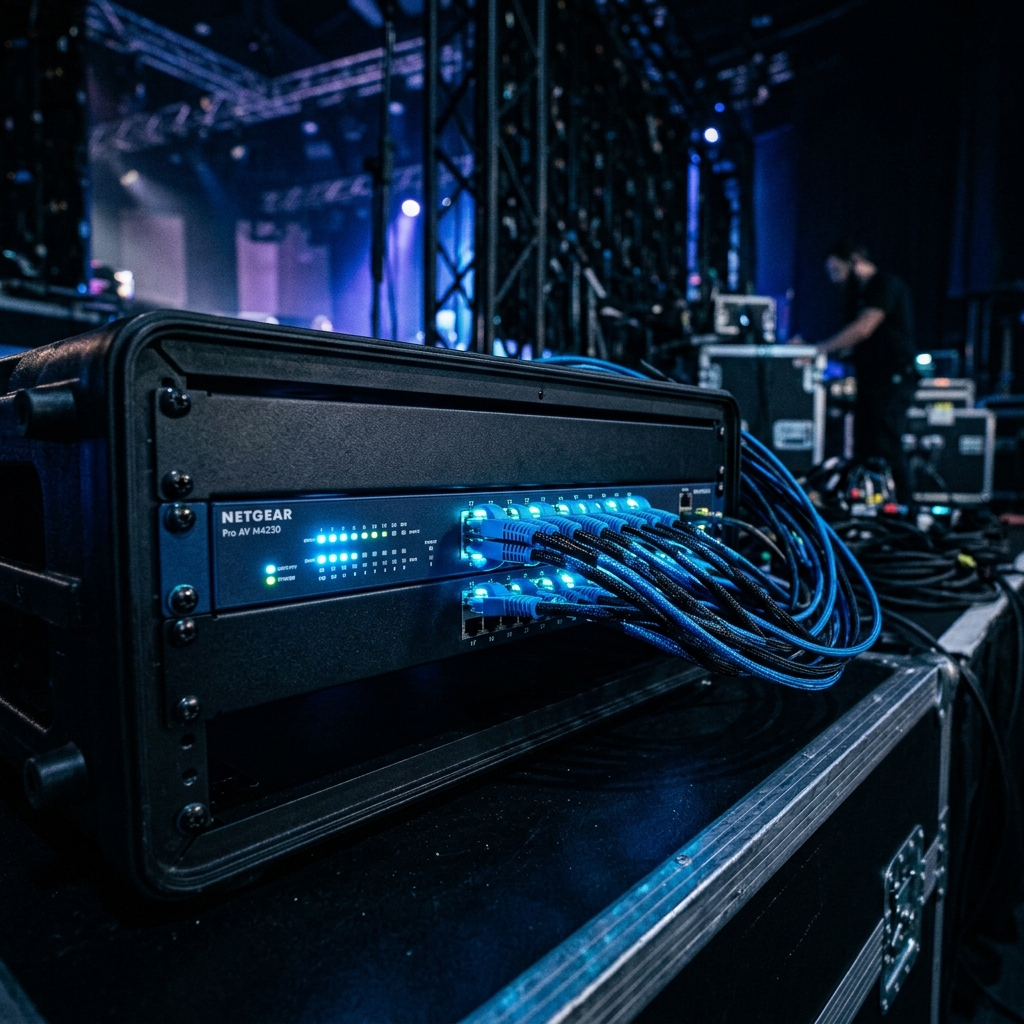
AV over IP replaces these dedicated signal paths with a single, unified transport layer: the Ethernet network. Instead of running an SDI cable from a camera to a switcher 200 feet away, an AV-over-IP encoder converts the video signal into IP packets and sends them across a standard Cat6 Ethernet cable - the same type of cable that connects your office computer to the internet. At the destination, an AV-over-IP decoder converts the packets back into a video signal. The same network can simultaneously carry audio, video, control data and intercom communications.
This is not a theoretical future - it's happening now. Across our work with brands like Ferrari, Porsche, NFL and pharmaceutical companies including Sanofi and BeiGene, we're seeing AV-over-IP protocols deployed at an accelerating rate. The technology has matured to the point where it's reliable enough for mission-critical corporate events and the cost advantages at scale make it increasingly attractive for multi-room conferences, permanent installations and large-format productions. For a broader view of how these technologies fit into professional AV production, see our detailed overview.
Traditional AV vs AV over IP: Side-by-Side
To understand why AV over IP matters, it helps to see exactly what it replaces and how the two approaches compare:
| Characteristic | Traditional AV | AV over IP |
|---|---|---|
| Cabling | Dedicated per signal type (SDI, HDMI, XLR, DMX) | Standard Cat6/Cat6a Ethernet for all signals |
| Maximum Distance | HDMI: 15m, SDI: 100–300m (coax dependent) | 100m per Ethernet run (unlimited with switches) |
| Routing Flexibility | Requires matrix switcher, fixed I/O count | Any-to-any routing via network, virtually unlimited I/O |
| Scalability | Limited by matrix size, expensive to expand | Add endpoints by connecting to network switch |
| Latency | Near-zero (electrical signal) | Sub-frame to 1–3 frames (protocol dependent) |
| Infrastructure Cost | Lower for small systems, escalates with scale | Higher initial investment, lower per-endpoint cost at scale |
| IT Knowledge Required | Minimal - AV-specific knowledge | Significant - networking, VLANs, QoS, multicast |
| Signal Types | Separate infrastructure per signal type | Audio, video, control and data on one network |
Key Protocols: The Standards That Matter
The AV-over-IP landscape includes multiple competing protocols, each designed for different use cases. Understanding these protocols is essential for specifying the right solution for your corporate event or permanent installation. If you're unfamiliar with any of the terminology below, our corporate event AV glossary provides plain-language definitions.
NDI (Network Device Interface) by Vizrt. NDI is the most widely adopted AV-over-IP protocol for live production. It carries video, audio and metadata over standard Gigabit Ethernet and is designed to be discoverable - NDI devices automatically find each other on the network without manual configuration. NDI comes in two flavors: full-bandwidth NDI (which uses approximately 100–150 Mbps per 1080p60 stream with visually lossless compression) and NDI|HX (which uses hardware-based H.264/H.265 compression to reduce bandwidth to 8–20 Mbps per stream at the cost of slightly higher latency). For corporate events, NDI is most commonly used for routing video between cameras, switchers, graphics systems and streaming encoders. Its broad adoption means hundreds of production tools natively support it - from PTZ cameras (like the PTZOptics and BirdDog lines) to software switchers (vMix, OBS, Wirecast) to hardware platforms (NewTek TriCaster, Vizrt systems).
Dante by Audinate. Dante is the dominant audio-over-IP protocol in professional audio production. It delivers uncompressed, multi-channel digital audio over Ethernet with sub-millisecond latency - low enough for live performance monitoring and critical audio applications. Dante has been adopted by virtually every major professional audio manufacturer: Yamaha, Allen & Heath, DiGiCo, Shure, Sennheiser, d&b audiotechnik, QSC and Biamp all offer Dante-enabled products. In a corporate event context, Dante replaces the traditional analog audio snake (a heavy, expensive multi-pair cable running from the stage to the mixing position) with a single Ethernet cable. A Dante-enabled stage box on stage connects to a Dante-enabled mixing console at front-of-house over standard Cat6, carrying 64 channels of uncompressed audio each direction - a capability that would require a massive copper snake or an expensive fiber-based digital snake in the traditional model.
AES67. AES67 is an open standard for audio-over-IP interoperability, published by the Audio Engineering Society. It provides a common framework that allows different audio-over-IP systems - Dante, Ravenna, Livewire and SMPTE ST 2110-30 - to exchange audio streams. For corporate events that use equipment from multiple manufacturers, AES67 compatibility ensures that a Dante-enabled Yamaha console can receive audio from a Ravenna-enabled stage box without proprietary bridges. It's an interoperability layer rather than a standalone protocol, but its importance in multi-vendor environments cannot be overstated.
SMPTE ST 2110. SMPTE ST 2110 is the broadcast-grade standard for transporting uncompressed video, audio and ancillary data over IP networks. Unlike NDI, which was designed for live production simplicity, ST 2110 was designed for broadcast facilities and major live events that require the same quality and reliability as traditional SDI infrastructure - but with IP's flexibility and scalability. ST 2110 treats video (ST 2110-20), audio (ST 2110-30/31 using AES67) and ancillary data (ST 2110-40) as separate, independently routable streams. It requires high-bandwidth networks (25GbE or 100GbE for uncompressed 4K) and precise clock synchronization (PTP - Precision Time Protocol). For most corporate events, ST 2110 is over-engineered; it's most relevant for broadcast facilities, large congress-style events and permanent installations where broadcast-grade quality and interoperability are required.
SDVoE (Software Defined Video over Ethernet). SDVoE is designed specifically to replace traditional AV matrix switchers with a network-based alternative that delivers zero-compression, zero-latency video transport. SDVoE transmits uncompressed 4K60 video over 10GbE networks with less than one frame of latency, making it suitable for applications where visible compression artifacts or latency are unacceptable - such as medical imaging, digital signage and high-end corporate presentation environments. The SDVoE Alliance (whose members include ZeeVee, Netgear and IDK) provides a standardized API that allows any SDVoE-compatible endpoint to work with any SDVoE-compatible switch.
AVB (Audio Video Bridging). AVB is an IEEE standard (802.1) that modifies Ethernet at the network layer to provide guaranteed bandwidth and timing for AV streams. Unlike other AV-over-IP protocols that work on standard Ethernet and rely on QoS policies, AVB requires AVB-capable network switches that enforce timing guarantees at the hardware level. The Milan protocol, built on AVB, has been adopted by manufacturers like d&b audiotechnik, Meyer Sound and Luminex for professional audio applications. AVB's advantage is deterministic performance - it guarantees that audio packets arrive on time regardless of other network traffic - but its requirement for AVB-capable switches limits adoption in temporary event environments where the network infrastructure is provided by the venue.
Why Traditional Matrix Switchers Are Being Replaced
To understand the shift toward AV over IP, you need to understand the limitations of the hardware it's replacing. A traditional AV matrix switcher is a dedicated hardware box that takes multiple video inputs (HDMI, SDI or DisplayPort) and routes them to multiple outputs. An 8×8 HDMI matrix, for example, accepts 8 HDMI inputs and can route any of them to any of 8 HDMI outputs.
Matrix switchers work perfectly for small-scale installations and simple event setups. But they hit hard walls as production complexity scales:
Fixed I/O limitations. An 8×8 matrix has exactly 8 inputs and 8 outputs. Need a 9th input? You either buy a larger matrix (16×16, which typically doubles the cost) or deploy a second matrix with additional routing complexity. AV over IP eliminates this constraint entirely - adding a source or destination is as simple as connecting another encoder or decoder to the network switch.
Distance constraints. HDMI signals degrade beyond 15 meters. Even with active extenders, HDMI over Cat5/6 is limited to approximately 70 meters. SDI extends further (up to 300 meters on quality coaxial cable), but still requires point-to-point cabling from every source to the matrix. AV over IP using standard Cat6 supports 100-meter runs to each network switch and switches can be cascaded indefinitely - meaning there's no practical distance limit on signal transport.
Cabling complexity for multi-room events. A corporate conference with a main ballroom, four breakout rooms and a lobby display - all needing to share video content - would require extensive homerun cabling from every source to a central matrix and then from the matrix to every display. This means pulling dozens of cables through a venue's ceiling and walls. With AV over IP, if the venue already has structured Ethernet cabling (most modern hotels and convention centers do), the AV team can leverage existing infrastructure with minimal additional cabling.
Benefits for Corporate Events
For the types of corporate events we produce at FPC - multi-room conferences, product launches, hybrid meetings and large general sessions - AV over IP offers several practical advantages:
Scalability. Adding a presentation source in a breakout room or a display in a lobby requires only an encoder or decoder and a network drop - not a new cable run back to a central matrix. For conferences with 10+ rooms sharing content, this flexibility significantly reduces infrastructure cost and setup time.
Distance. Convention centers are large. A backstage technical area might be 400 feet from the furthest breakout room. Traditional AV would require either fiber converters (expensive) or SDI with signal boosters. AV over IP uses the venue's existing network infrastructure, with managed switches deployed at intermediate points as needed.
Flexibility during the event. With traditional AV, changing a signal route means physically repatching cables or reconfiguring a matrix switcher. With AV over IP, routing changes are made in software - a stream can be redirected from one display to another with a few clicks in the management interface. This is invaluable during corporate events where the program changes constantly and the production team needs to adapt quickly.
Reduced truck pack and load-in time. AV-over-IP endpoints (encoders and decoders) are small, lightweight devices - many are PoE-powered (Power over Ethernet), meaning they get both data and power from a single Cat6 cable. Compare this to the road cases full of matrix switchers, SDI distribution amplifiers, HDMI extenders and associated power supplies required for a traditional deployment. The reduced physical footprint translates directly to faster load-in and load-out - critical for venues with tight scheduling and union labor costs.
Cost efficiency at scale. While a single NDI encoder might be more expensive upfront (versus a standard HDMI cable for a direct connection), the economics flip at scale. A 32×32 HDMI matrix switcher requires a significant capital investment. Deploying 32 NDI encoders and 32 decoders over existing network infrastructure might cost a similar amount - but with the added flexibility of any-to-any routing, no I/O limits and the ability to add endpoints incrementally rather than replacing the entire matrix.
Ready to Elevate Your Next Event?
FPC delivers flawless AV production for corporate keynotes, product launches and hybrid conferences.
Get a Production QuoteChallenges and Considerations
AV over IP is not a universal improvement over traditional AV. It introduces challenges that production teams and event managers need to understand:
Latency. Traditional SDI and HDMI connections have near-zero latency - the signal arrives at the display essentially instantly. AV-over-IP protocols introduce some latency due to encoding, packetization, network transit and decoding. For IMAG (Image Magnification) on LED walls where the audience can see both the live presenter and the magnified image, latency above 1–2 frames becomes noticeable and distracting. Protocols like SDVoE and full-bandwidth NDI keep latency under one frame, but compressed protocols like NDI|HX may introduce enough delay to be problematic for IMAG applications.
Bandwidth requirements. Uncompressed 4K60 video requires approximately 12 Gbps of bandwidth. Even compressed 1080p60 via NDI requires 100–150 Mbps per stream. Deploying multiple video streams on a network requires managed switches with sufficient backplane capacity, proper IGMP snooping configuration to control multicast traffic and enough port bandwidth to handle all simultaneous streams without congestion. A 16-source, 16-destination NDI deployment at 1080p60 could require over 2 Gbps of aggregate network bandwidth - well within the capacity of modern managed switches, but far beyond what an unmanaged consumer switch can handle.
Network infrastructure requirements. AV over IP demands enterprise-grade managed network switches - not the consumer routers and unmanaged switches that some venues provide. The switches must support IGMP snooping (to manage multicast traffic efficiently), QoS (Quality of Service) policies (to prioritize AV traffic over data traffic) and sufficient port capacity and backplane bandwidth for the number and resolution of AV streams being deployed.
IT department coordination. This is perhaps the most significant practical challenge. Traditional AV infrastructure is entirely self-contained - the AV team deploys their own cables, their own switchers and their own control systems with no interaction with the venue's IT department. AV over IP, by definition, runs on network infrastructure that may be managed by the venue's IT team. This creates a coordination requirement that didn't previously exist and it can be a source of friction if the AV and IT teams don't communicate effectively.
Troubleshooting complexity. When a traditional SDI signal doesn't work, the troubleshooting process is straightforward: check the cable, check the connectors, check the source and destination settings. When an AV-over-IP stream doesn't work, the troubleshooting process might involve checking VLAN assignments, IGMP snooping tables, multicast group memberships, switch port configurations, firmware versions and network addressing - skills that sit at the intersection of AV expertise and network engineering.
What IT Departments Need to Know
If your corporate event involves AV over IP and the venue's IT department manages the network infrastructure, here's what they need to prepare:
VLAN configuration. AV traffic should be isolated on a dedicated VLAN, separate from corporate data, guest Wi-Fi and other network services. This VLAN needs to be configured on every switch port where AV encoders, decoders or control devices will be connected. The AV VLAN should have its own DHCP scope or use static IP addressing as specified by the AV team.
QoS (Quality of Service) policies. Network switches should be configured to prioritize AV traffic - specifically, DSCP (Differentiated Services Code Point) markings used by the AV protocol. Dante uses DSCP EF (Expedited Forwarding, value 46) for time-critical audio packets. NDI and other video protocols should be marked with appropriate priority levels. QoS ensures that AV streams maintain consistent quality even if other network traffic creates congestion.
Multicast configuration. Most AV-over-IP protocols use multicast to distribute streams efficiently - one encoder sends a single stream and multiple decoders on the network can subscribe to it without the encoder duplicating traffic. This requires IGMP snooping to be enabled on all switches so that multicast traffic is only forwarded to ports with subscribed receivers, not flooded to every port on the network (which would overwhelm bandwidth). Some protocols also require a multicast querier or PIM (Protocol Independent Multicast) router on the network.
Bandwidth planning. The IT department needs to understand the total bandwidth requirement for the AV deployment. Provide them with the number of streams, the resolution and frame rate of each stream, the protocol being used and the resulting per-stream and aggregate bandwidth numbers. This allows them to verify that the switch infrastructure and inter-switch links have sufficient capacity.
Clock synchronization. Protocols like SMPTE ST 2110 and AVB require PTP (Precision Time Protocol, IEEE 1588) for clock synchronization across the network. This requires PTP-aware network switches that support boundary clock or transparent clock functionality. Dante uses its own clock synchronization mechanism that works on standard managed switches without PTP support.
When AV over IP Makes Sense
Based on our experience across hundreds of corporate events, AV over IP delivers clear advantages in these scenarios:
Multi-room conferences and conventions. When content needs to be shared across 5+ rooms with flexible routing - keynote presentations distributed to overflow rooms, breakout content routed to lobby displays, all sessions captured for recording - AV over IP's any-to-any routing eliminates the need for massive cable runs and expensive matrix switchers.
Venues with existing structured cabling. Modern hotels and convention centers have extensive Ethernet infrastructure. If the venue has Cat6 drops in every meeting room, deploying AV over IP leverages existing cable plant rather than pulling new dedicated AV cable.
Productions requiring long cable distances. When the technical control position is 300+ feet from the stage or display locations, AV over IP avoids the need for SDI over fiber converters or long-distance HDMI extenders.
Recurring events in the same venue. If your company holds a quarterly town hall or annual conference in the same venue, investing in a repeatable AV-over-IP infrastructure design pays dividends - each subsequent event deploys faster because the network configuration is documented and proven.
When Traditional Still Wins
AV over IP is not always the right answer. Traditional AV infrastructure remains the better choice in these scenarios:
Simple, small-scale setups. A presentation in a single meeting room with a laptop, a projector and two microphones does not benefit from AV over IP. A standard HDMI cable is faster to deploy, more reliable (no network configuration needed) and cheaper than an encoder-decoder pair.
Critical IMAG applications. When image magnification timing is critical - large general sessions where the audience sees both the live presenter and the LED wall simultaneously - the sub-frame latency of direct SDI connections may be preferable to the 1–3 frame latency of compressed AV-over-IP protocols. Full-bandwidth NDI and SDVoE achieve acceptable IMAG latency, but compressed protocols may not.
Venues with poor or inaccessible network infrastructure. If the venue's network infrastructure is outdated, unmanaged or controlled by an IT department that can't accommodate AV VLAN and QoS requirements, deploying AV over IP creates more problems than it solves. In these cases, self-contained traditional AV infrastructure is more reliable.
Extremely time-constrained load-ins. Setting up and configuring AV-over-IP infrastructure - including network switch deployment, VLAN configuration and endpoint discovery - takes more time than running point-to-point SDI cables. For productions with 2-hour load-in windows, traditional AV's simplicity is an advantage.
How FPC Implements AV over IP
As a production consultant, FPC takes a technology-agnostic approach to AV over IP. We don't advocate for network-based AV because it's trendy - we specify it when the production requirements, venue infrastructure and budget analysis justify it. Here's how we approach AV-over-IP decisions for our clients:
We evaluate on a project-by-project basis. Every event gets an honest assessment of whether AV over IP or traditional infrastructure (or a hybrid of both) is the right approach. For a 200-person general session with a single stage and two IMAG screens, we'll typically specify direct SDI. For a 5-room pharmaceutical conference with content sharing across all rooms and a remote streaming component, we'll design an NDI and Dante backbone.
We bridge the AV-IT gap. One of the biggest challenges with AV over IP at corporate events is the communication gap between the AV production team and the venue's IT department. With 13+ years of production experience across 500+ show days, our team speaks both languages fluently. We create detailed network requirement documents for IT departments, specify exact VLAN, QoS and multicast configurations and coordinate directly with venue IT staff to ensure the network is configured correctly before load-in. This coordination role is a core part of our live streaming and video production services.
We design hybrid systems. Many of our productions use both traditional and IP-based AV simultaneously. A typical hybrid design might use direct SDI for the main stage camera infrastructure (where latency is critical for IMAG), Dante for the entire audio system (where the flexibility and simplicity of networked audio is a clear win) and NDI for distributing content to breakout rooms and streaming encoders (where the flexibility of network routing outweighs the slight latency penalty). This pragmatic, best-tool-for-each-job approach delivers better results than dogmatically committing to one technology.
If you're planning an event that might benefit from AV-over-IP technology - or if your IT department is asking questions about AV network requirements that your current production team can't answer - contact FPC. We provide the technical expertise to design, specify and manage AV-over-IP deployments that actually work in real-world event environments.