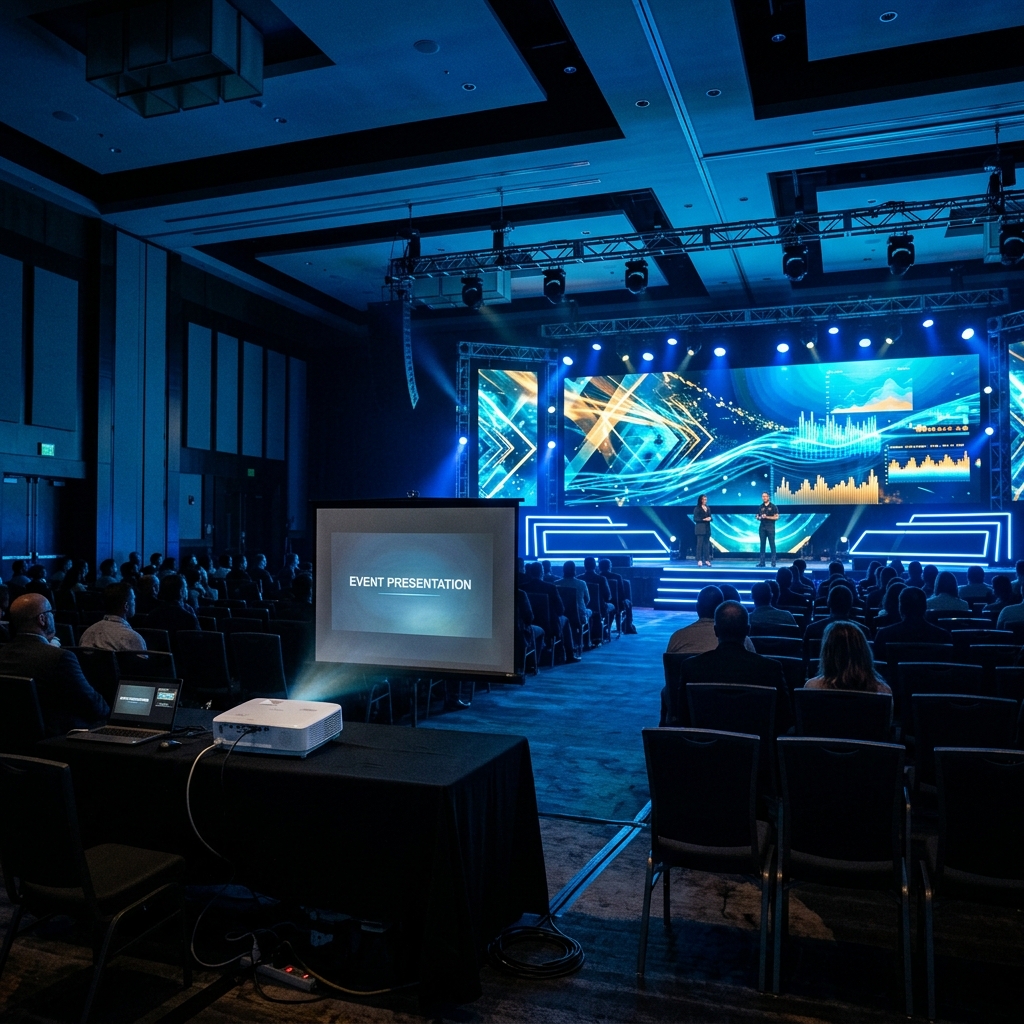
Understanding the Two Models
The in-house AV model has been the default for decades. Hotels and convention centers partner with AV companies - sometimes national chains like Encore (formerly PSAV) or Cvent, sometimes regional providers - who install permanent equipment in the venue and provide on-site technicians. When you book the venue, the in-house AV company is typically presented as the "preferred" or "exclusive" provider. Their equipment is already in the building, their team knows the venue's infrastructure and ordering from them is as simple as checking boxes on an order form.
The external AV model involves hiring an independent production company or rental house to bring equipment into the venue, set it up, operate it during the event and strike it afterward. This requires more logistical coordination - loading docks, freight elevators, power distribution, rigging points - but gives you access to a much wider range of equipment, dedicated crew and production expertise that venue-based providers rarely match.
Both models have legitimate advantages. The problem is that most event planners only hear the venue's side of the story - and the venue has a strong financial incentive to steer you toward their in-house provider. Understanding the real trade-offs requires looking beyond the convenience factor and examining equipment quality, crew expertise, pricing transparency and creative capability.
What In-House AV Provides
In-house AV providers offer genuine benefits that are worth understanding and acknowledging. Here's what you actually get when you use the venue's AV team:
Venue familiarity. The in-house team knows the building intimately - where every power outlet is, which walls can support rigging, how the house lighting system works, where the freight elevator is and what the loading dock schedule looks like. This institutional knowledge eliminates the learning curve that outside companies face on their first visit to a venue. For simple events, this familiarity translates directly to faster setup times and fewer logistical surprises.
Pre-installed infrastructure. Most in-house providers have permanently installed equipment - ceiling-mounted projectors, built-in speaker systems, house lighting, in-wall cabling and patch panels. For a basic meeting with a projector, screen and podium microphone, this permanent infrastructure means minimal setup time and lower cost, because the equipment is already in place and doesn't need to be trucked in, assembled and struck.
Convenience. Ordering in-house AV is simple. You receive a menu-style order form, select the items you need and the equipment appears in your room at the scheduled time. There are no logistics to manage - no trucking, no loading dock coordination, no rigging permits. For event planners managing dozens of other details, this simplicity has real value.
Single-point billing. In-house AV charges typically appear on your master hotel bill, which simplifies accounting and consolidates vendor management. For organizations with strict procurement processes, having one fewer vendor to onboard can be administratively advantageous.
Basic technical support. In-house teams provide technicians who can set up equipment, run a soundcheck, manage microphones during a presentation and troubleshoot basic issues. For straightforward events - a half-day meeting, a dinner presentation, a small breakout session - this level of support is often sufficient.
What External AV Provides
External AV companies operate on an entirely different model - one built around delivering production excellence rather than venue convenience. Here's what an outside provider brings to the table:
Current-generation equipment. This is perhaps the single biggest differentiator. External production companies and rental houses compete on equipment quality - their business depends on having the latest projectors, LED wall panels, speaker systems, wireless microphones and switching equipment. A top rental house regularly invests in new inventory: Panasonic PT-RQ35K laser projectors, d&b audiotechnik KSL line arrays, ROE Visual Black Pearl LED panels, Shure Axient Digital wireless systems. In-house providers, by contrast, often operate equipment that was installed years ago and may not have been upgraded since. We've walked into hotel ballrooms with ceiling-mounted projectors producing 5,000 lumens when the room needed 20,000 - equipment that was acceptable when installed eight years ago but is now woefully inadequate.
Dedicated, specialized crew. External production companies employ or contract specialists - A1 audio engineers who live and breathe wireless coordination, video engineers who can troubleshoot SDI signal chains in their sleep, lighting designers who understand the nuances of corporate stage design. In-house technicians are often generalists who handle audio, video and lighting across multiple rooms simultaneously. When your CEO is on stage delivering a keynote to 1,000 people, you want a dedicated engineer whose only job is making that microphone sound perfect - not someone splitting attention between your ballroom and the wedding next door.
Production design and creative capability. External production companies don't just provide equipment - they design the production. They create lighting plots that reinforce your brand identity, design stage layouts that optimize sight lines and camera angles, specify LED wall configurations that maximize visual impact and engineer audio systems tuned for the specific acoustics of your room. In-house AV teams rarely offer this level of design thinking - they fulfill equipment orders, but they don't architect the experience.
Scalability and flexibility. An external company can scale to any event size and complexity. Need a 40-foot LED wall for a product launch? A 24-camera IMAG setup? A fiber-connected multi-room audio distribution system? External companies source exactly what you need from a vast network of equipment providers. In-house teams are limited to what's installed in the building and what they can sub-rent - and their sub-rental options are often limited to their parent company's inventory.
Show management and production oversight. External production companies provide show callers, technical directors and production managers who coordinate every technical department in real time during the event. This management layer - which simply doesn't exist in the in-house model - is what separates a "meeting with AV" from a "produced event." If you want to understand the full scope of what production management entails, we've covered it in detail in our guide on AV production vs. AV rental.
Side-by-Side Comparison
| Factor | In-House AV | External AV Company | Production Consultant (FPC) |
|---|---|---|---|
| Equipment Quality | Often older, venue-installed | Current-generation, event-specific | Best-fit from any vendor |
| Crew Expertise | Generalists, shared between rooms | Specialists, dedicated to your event | Hand-picked specialists for each role |
| Production Design | Basic equipment fulfillment | Full technical design | Full design, vendor-agnostic sourcing |
| Pricing Transparency | Venue-marked-up rates | Competitive market rates | Full transparency, no equipment markup |
| Setup Convenience | High - equipment pre-installed | Moderate - requires load-in | Managed - consultant handles logistics |
| Show Calling | Not available | Available | Included |
| Scalability | Limited to venue inventory | Unlimited - full market access | Unlimited - best vendor for each element |
| Best For | Simple meetings, basic presentations | Mid-to-large produced events | High-stakes corporate, pharma, automotive |
Ready to Elevate Your Next Event?
FPC delivers flawless AV production for corporate keynotes, product launches and hybrid conferences.
Get a Production QuoteThe Hidden Costs of In-House AV
The perception that in-house AV is cheaper is one of the most persistent myths in the event industry. While in-house pricing can be lower for the simplest setups, the full picture tells a more nuanced story. Understanding these hidden costs is essential for making an informed decision about what AV production really costs.
Venue commissions. This is the elephant in the room that in-house AV providers never discuss with clients. Hotels charge their in-house AV partner a commission - typically 30–50% of all AV revenue generated in the property. Read that again: 30–50%. That means if your in-house AV bill is substantial, a large portion of that goes to the hotel as a commission, not toward equipment or crew. The in-house provider must cover their own costs and profit from the remaining 50–70%. This commission structure is the primary reason in-house AV pricing is often significantly higher than external market rates for equivalent equipment and labor.
Equipment age and quality gaps. In-house equipment installations are capital expenditures that venues amortize over 5–7 years or longer. That ceiling-mounted projector was state-of-the-art when it was installed, but technology evolves rapidly. A 6,000-lumen projector installed five years ago is outclassed by 10,000+ lumen laser projectors available from any rental house today. Older wireless microphone systems may operate on frequencies that have been reallocated to cellular services, creating interference problems. Aging speaker systems may lack the clarity and output of modern line arrays. You're paying current-year prices for multi-year-old technology.
Limited inventory, expensive additions. In-house AV providers stock equipment for the venue's most common event configurations. When your event needs something beyond that standard package - additional wireless microphones, larger speakers, LED video walls, cameras for IMAG, streaming equipment - the in-house provider must sub-rent those items from external sources, adding their own markup on top of the rental cost. You end up paying a middleman premium for equipment that an external company could have provided directly at a lower cost.
Crew allocation and attention. In-house AV teams serve the entire venue, often simultaneously supporting multiple events across multiple rooms. On a busy Saturday at a large hotel, the same technician might be responsible for your 500-person keynote, a wedding in the adjacent ballroom and a corporate dinner in the restaurant. Their attention is divided, their response time to issues is slower and their ability to rehearse and prepare for your specific event is limited. An external production company provides a crew that is 100% dedicated to your event from load-in through strike.
Lack of pre-production planning. In-house AV teams typically don't conduct detailed pre-production planning - site visits, technical drawings, signal flow diagrams, show flow development, rehearsal coordination. They receive an equipment order, set it up on the day and operate it. For simple events, this is fine. For complex productions, the absence of pre-production planning is where problems originate - the wrong screen size for the room, insufficient audio coverage, lighting that doesn't complement the video wall and dozens of other issues that proper planning would have caught weeks before the event.
When In-House Makes Sense
Despite the limitations, there are legitimate scenarios where using the venue's in-house AV is the smart choice. We believe in honest advice - even when it means acknowledging that hiring an outside company isn't always necessary:
Simple meeting room setups. A half-day meeting with a projector, screen, two wireless microphones and a small speaker system. The technical complexity is low, the stakes are manageable and the in-house team's venue familiarity is a genuine advantage. For these events, the convenience and lower logistics overhead of in-house AV make it the practical choice.
Short-notice events. When an event is booked with less than a week's notice and requires basic AV, in-house is often the only viable option. External companies need time for equipment sourcing, crew booking and logistics coordination. The in-house team can deploy from their on-site inventory within hours.
Budget-constrained events where AV is secondary. A networking reception, a dinner with a brief toast or a registration area that just needs background music. When the audiovisual component is a supporting element rather than the focal point, in-house AV provides adequate quality at minimal cost and complexity.
Venue-mandated exclusivity. Some venues have truly exclusive in-house AV contracts that prohibit outside vendors entirely (though this is becoming less common as event planners push back). When exclusivity is non-negotiable, you work with what you have - but even in these situations, bringing in an external production consultant to manage the in-house team can dramatically improve the result.
When You Need External AV
For many corporate events, the in-house AV model simply cannot deliver what the event demands. Here are the clear indicators that you need to bring in an outside provider:
LED video walls and large-format displays. Few in-house AV providers stock LED wall panels - and those that do often have limited inventory in older pixel pitches. If your stage design calls for an LED wall (increasingly common for product launches, keynotes and brand activations), you need an external provider who can source the right panels, build the wall structure and calibrate the display for your specific content and ambient lighting conditions.
Multi-camera IMAG and livestreaming. Image magnification (IMAG) and livestreaming require cameras, a video switcher, a technical director and often a separate streaming encoder with dedicated internet connectivity. This is specialized production work that demands experienced camera operators, a skilled TD and proper broadcast engineering. In-house AV teams almost never offer this capability in-house - and when they sub-contract it, you lose the quality control and integration benefits of a unified production team.
Complex audio requirements. Events with more than 8 wireless microphone channels, line array speaker systems, multi-zone audio distribution or broadcast-quality mixing require a dedicated A1 audio engineer with proper RF coordination tools. In-house sound systems - typically ceiling-mounted speakers designed for background music and basic speech reinforcement - are not engineered for concert-level corporate keynotes or large plenary sessions where intelligibility at the back of a 300-foot ballroom is critical.
Branded stage and lighting design. When the stage environment IS the brand experience - as with automotive reveals, pharmaceutical congress presentations or major product launches - you need a lighting designer who can translate your brand guidelines into a visual environment that reinforces your message. This means custom lighting plots, gobo projections, LED uplighting, follow spots and theatrical programming that in-house AV teams are not equipped or trained to deliver.
High-stakes, high-visibility events. Product launches, investor days, board presentations, annual general meetings, medical symposiums - events where a technical failure would have real business consequences. For these events, the production company's pre-planning, redundancy design, rehearsal protocols and show-day management are not optional luxuries. They are risk mitigation. When we produce events for clients like Ferrari, Porsche, NFL, Sanofi or BeiGene, the production investment is a fraction of the reputational cost of a failed show.
Negotiating with Venues: Bringing In Outside AV
One of the most common concerns event planners have about external AV is the logistics of bringing equipment into a venue that has an in-house provider. This is a legitimate concern - but it's far more manageable than most planners realize. Here's what you need to know:
Your right to choose. In most jurisdictions, venues cannot legally force you to use their in-house AV provider. They can make it the default, they can recommend it and they can charge you fees for using outside vendors - but they typically cannot prohibit it. The exception is truly exclusive contracts, which are becoming rarer as the market evolves. Always ask about outside vendor policies before signing a venue contract.
Negotiate during venue selection, not after. The time to negotiate outside AV terms is before you sign the venue contract - not after you've committed. Include language in your contract that explicitly permits outside AV vendors, specifies any fees associated with outside vendors (power drops, rigging points, internet access) and outlines the venue's cooperation requirements (loading dock access, freight elevator scheduling, rigging point availability). Once the contract is signed, your negotiating leverage drops significantly.
Understand the fee structure. Common venue fees for outside AV include: electrical labor and power distribution , rigging points, internet/network access and general service or "facilities" charges. These fees are real costs, but they're often negotiable - especially if you're booking a significant room block or food and beverage commitment that makes the venue want to keep your business.
Build a relationship, not an adversarial dynamic. The best outcomes happen when the external AV company and the venue's operations team work collaboratively. Experienced production companies - and certainly production consultants - know how to work with venue staff, respect load-in/load-out schedules, protect the facility and leave the space in better condition than they found it. This collaborative approach benefits everyone and often leads to venues waiving or reducing outside vendor fees for repeat clients.
How FPC Works with Venues
As a production consultant, FPC operates in a unique space that bridges the in-house and external AV models. We don't own equipment, we don't compete with in-house providers and we don't have a financial incentive to push clients toward outside gear when in-house would serve them well. This vendor-agnostic approach - the core of the production consultant model - gives us the objectivity to recommend whatever serves the client's event best.
Here's how that plays out in practice across our engagements with clients like Ferrari, Porsche, NFL, Mobile World Congress, Sanofi, BeiGene, IPSEN, UCB and Baxter:
We assess before we recommend. Every engagement starts with a thorough assessment of the venue's in-house capabilities. What equipment do they have? How old is it? What's their crew's experience level? Can they deliver the production quality the event demands? Sometimes the answer is yes - the in-house team is perfectly capable and we provide the design and management layer on top of their equipment and crew. Sometimes the answer is no and we bring in external partners who can deliver what the event requires.
We negotiate venue terms on your behalf. With 13+ years of experience and 500+ show days at venues across North America, we understand venue fee structures, we know what's negotiable and we know how to frame outside AV as a benefit to the venue rather than a threat to their revenue. We've saved clients thousands of dollars in venue fees simply by having the right conversations at the right time in the contracting process.
We manage the hybrid model. Many of our most successful events use a hybrid approach - in-house equipment for basic meeting rooms and breakout sessions, combined with external production for the main stage and keynote presentations. This hybrid model captures the convenience and cost savings of in-house for simple needs while delivering production excellence where it matters most. As a consultant, we design and manage this hybrid seamlessly, so the client experiences a single, unified production - not a confusing mix of two separate vendors.
We bring the expertise layer that both models lack. Whether you use in-house AV, external AV or a hybrid, the one thing neither model automatically provides is production management - the show calling, technical direction, creative oversight and real-time problem-solving that ensures every element works together as a cohesive production. That's exactly what a production consultant provides and it's the reason our clients trust us to deliver consistent, flawless results across 100+ brands, regardless of which equipment vendor is involved.
The bottom line is this: the "in-house vs. external" question isn't really about where the equipment comes from. It's about whether your event has the design thinking, production management and technical oversight it needs to succeed. The equipment is a commodity. The expertise is the differentiator.
If you're planning a corporate event and want an honest assessment of whether in-house AV will meet your needs or whether you should bring in outside help, reach out to us. We'll evaluate your specific situation and give you a straight answer - because that's what a consultant does.